
SRPE Water Pipe
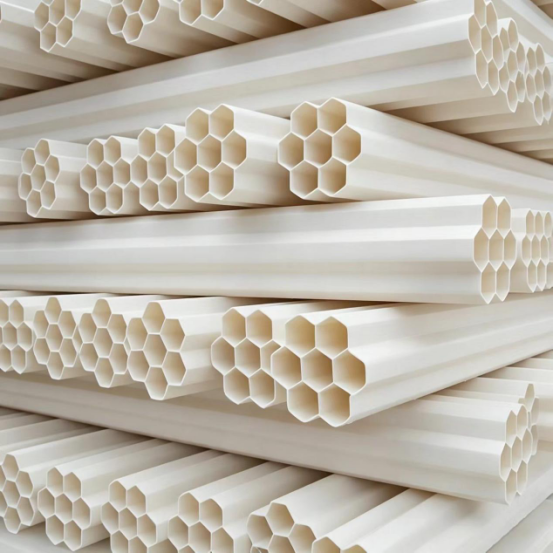
Plum-blossom conduit
- Product details
- Contact us
Product Introduction
"Plum-blossom" conduit (also known as honeycomb conduit or multi-bore conduit) is a type of integrated, multi-channel protective piping used for telecommunications and power infrastructure. Its cross-section resembles a plum blossom, featuring multiple independent internal channels. It is primarily used for housing, isolating, and protecting underground fiber-optic cables, electrical cables, and communication or power lines. Key advantages include a multi-channel design within a single unit, ease of cable installation, the availability of spare channels, and high construction efficiency. These conduits are typically manufactured via a single-pass extrusion process, resulting in a unified, multi-bore structure. Taking the common seven-bore version as an example: the cross-section is plum-blossom-shaped with seven distinct internal channels—a solid reinforcing rib at the center, surrounded by the other channels. Both the inner and outer walls are smooth, and the channels are separated from one another, facilitating the organized installation and protection of various cables. This design allows multiple fiber-optic or electrical cables to be housed within a single conduit, while also providing spare channels for future capacity expansion.
Product Features
1. Integrated multi-bore design with high channel utilization: The conduit contains multiple independent channels, enabling the simultaneous installation of several fiber-optic or electrical cables. Different lines can be isolated in separate channels, and empty channels can be reserved for future expansion, thereby avoiding the need for repeated excavation or additional construction work.
2. Smooth inner walls for efficient cable installation: The inner walls are typically smooth with a low coefficient of friction, which minimizes resistance during cable pulling. This makes the conduit well-suited for fiber-optic cables, communication cables, power cables, and low-voltage line installations.
3. Excellent compressive and impact resistance: The integrated multi-bore structure provides internal support between the channels, ensuring an even distribution of external forces. High-quality versions typically meet an annular stiffness rating of SN8 or higher, making them suitable for underground burial and capable of withstanding soil pressure and surface loads.
4. Corrosion resistance, ideal for underground use: Generally made from plastic, these conduits offer strong resistance to acids, alkalis, salts, and moisture-rich soil environments. Compared to metal pipes, these are less prone to corrosion, making them suitable for long-term use in underground telecommunications and power conduit systems.
5. Excellent flexibility, allowing them to adapt to ground settlement; HDPE "plum-blossom" (multi-cell) conduits, in particular, offer superior flexibility and impact resistance.
They are well-suited for challenging conditions, including uneven ground settlement, minor surface deformation, complex underground environments, and construction in low-temperature settings.
6. Good insulation properties; these conduits provide excellent electrical insulation, making them ideal for protecting telecommunications, power, and low-voltage lines, thereby enhancing operational safety.
7. Ease of installation; these conduits typically utilize socket-type or sleeve-type connections, requiring no specialized or overly complex tools for installation. General installation requirements include: ensuring the trench bottom is as level and straight as possible (a layer of fine sand may be used if the bottom is uneven), and removing any hard debris from the trench to prevent damage to the pipes.
When extending pipe ends into manholes or handholes, a sufficient length should be reserved, and the pipe openings must be sealed to prevent the ingress of mud, sand, or stones.
Applicable Standard
YD/T 841.5-2016
Common Specifications
75mm, 76.5mm, 100mm, 108mm, 110mm
Scope of Application
These multi-cell ("plum-blossom") conduits are primarily used for the protection of underground cables. Common applications include:
Telecommunications infrastructure: protective conduits for fiber-optic and communication cables.
Network infrastructure for telecommunications operators (e.g., China Mobile, China Unicom, China Telecom, and broadcasting/cable networks).
Conduit systems for 5G base stations.
Fiber-to-the-home (FTTH) projects.
Urban underground telecommunications conduit networks.
Protection for power cables.
Low-voltage conduit networks for residential communities.
Telecommunications conduit networks for municipal roads.
Telecommunications conduits along highways and railways.
Cabling for smart city surveillance/monitoring systems.
Cable protection in industrial facilities and mining areas.
Wuhan Tongzhu Pipeline Technology Development Co., Ltd.
WhatsApp:18971678318
Email:525444153@qq.com
Address:Room 2108, Juhao Huating, No. 460 Wuluo Road, Wuchang District, Wuhan
QQ:525444153
Website:www.tongzhupipe.com