
SRPE Water Pipe
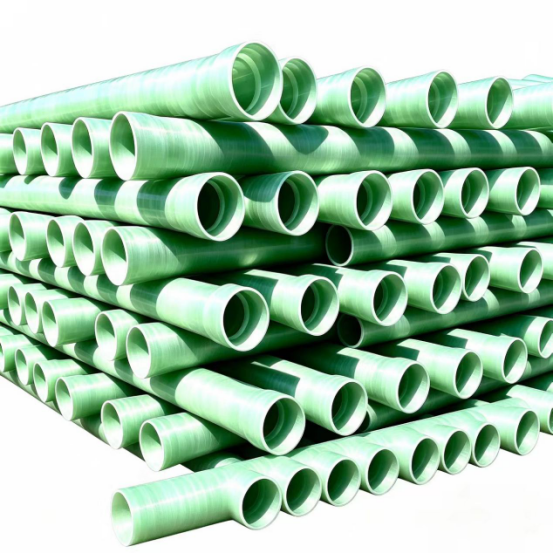
Glass-fiber reinforced sand-filled pipe
- Product details
- Contact us
Product Introduction
Fiberglass-reinforced plastic mortar (FRPM) pipes—also known as glass-fiber-reinforced plastic (FRP) mortar pipes or RPM pipes—are composite pipes manufactured using resin as a matrix, glass fiber (and its derivatives) as reinforcement, and inorganic particles such as quartz sand as filler. They are primarily used for fluid transport and buried pipeline projects, including municipal water supply and drainage, sewage disposal, industrial wastewater transport, water diversion, and seawater conveyance. The pipe structure consists of several layers: an inner liner, which provides corrosion and leakage resistance and comes into direct contact with the transported medium; a structural/mortar layer, composed of a composite of resin, glass fiber, and quartz sand, which provides strength and rigidity; and an outer protective layer, which offers resistance to aging and ultraviolet (UV) radiation, while protecting the exterior of the pipe.
Product Features
1. Excellent Corrosion Resistance: FRPM pipes exhibit high tolerance to a wide range of chemical media, making them suitable for environments involving acids, alkalis, salts, seawater, municipal sewage, industrial wastewater, and corrosive soils. Unlike traditional metal pipes—such as steel or cast-iron pipes—they are not prone to corrosion-related issues like rusting or perforation.
2. Lightweight and High-Strength: With a specific gravity typically ranging from 1.65 to 2.0, FRPM pipes are significantly lighter than steel, cast-iron, or concrete pipes. This facilitates easier transport, loading, unloading, and installation, while also reducing labor intensity during construction. Despite their low weight, the glass-fiber-reinforced structure ensures high strength and rigidity, making them well-suited for buried pipeline applications.
3. Superior Hydraulic Performance: The smooth inner surface of FRPM pipes results in low fluid resistance and high transport efficiency. Typical hydraulic performance characteristics include a Manning’s roughness coefficient of approximately 0.008–0.009 and a friction resistance coefficient (n) ≤ 0.0084. Given the same flow rate, these pipes allow for the use of smaller diameters or a reduction in pumping energy consumption. Consequently, they are frequently employed in projects with high hydraulic performance requirements, such as municipal water supply and drainage, stormwater discharge, sewage transport, and water diversion schemes.
4. Long service life: Under standard conditions for design, construction, and operation, glass-fiber reinforced sand-filled pipes (GRP/FRPM pipes) typically have a service life of 50 years or more. This longevity is attributed to several factors: the corrosion resistance of the resin matrix, the reinforcing effect of the glass fibers, the structural rigidity provided by the sand-filled layer, and the anti-aging properties of the outer protective layer.
5. Resistance to internal scaling: The inner surface of these pipes is smooth, making it resistant to the accumulation of debris and the growth of algae or microorganisms. In applications such as water supply, drainage, sewage transport, and industrial water conveyance, this helps maintain the pipeline’s long-term hydraulic capacity while reducing the need for desilting and maintenance. 6. High design flexibility: Glass-fiber reinforced plastic (GRP) mortar pipes can be customized according to specific project requirements—including pipe diameter, wall thickness, pressure rating, ring stiffness, resin type, corrosion resistance, and temperature resistance. Consequently, they are suitable for a wide range of operating conditions, from standard drainage to pressurized water transport, industrial fluid conveyance, and seawater transport.
Executive Standard
GB/T 21238-2016
Common Specifications (Nominal Diameters)
300, 400, 500, 600, 700, 800, 900, 1000, 1200, 1400, 1500, 1600, 1800, 2000, 2200, 2400
Scope of Application
GRP mortar pipes are primarily used for fluid transport and buried pipeline projects. Common applications include:
Municipal water supply systems
Municipal drainage systems
Stormwater drainage networks
Sewage discharge systems
Inlet and outlet pipelines for wastewater treatment plants
Industrial wastewater transport
Transport of corrosive media in the chemical industry
Seawater transport
Agricultural irrigation
Water diversion projects
Reservoir water transfer projects
Mine tailings transport
Protective conduits for power and telecommunications cables
Large-diameter water supply and drainage, sewage discharge, water diversion, and corrosion-resistant industrial fluid transport are among the most typical application scenarios for GRP mortar pipes.
Wuhan Tongzhu Pipeline Technology Development Co., Ltd.
WhatsApp:18971678318
Email:525444153@qq.com
Address:Room 2108, Juhao Huating, No. 460 Wuluo Road, Wuchang District, Wuhan
QQ:525444153
Website:www.tongzhupipe.com